Time Zone Overlap Planner for Offshore Teams
Pick your office time zone, your offshore team’s country and shift, and a date. See exactly how many hours you share, when handed-off work comes back, and the shift that would give full overlap.
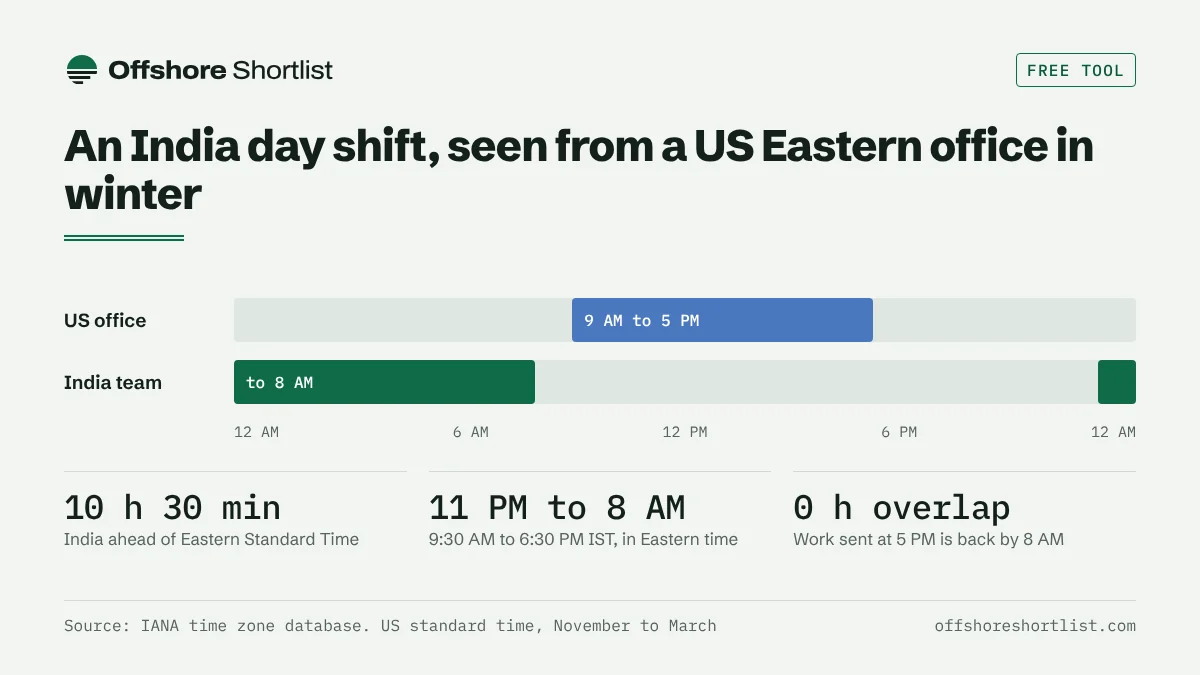
A team in India working a normal day shift (9:30 AM to 6:30 PM local time) overlaps zero hours with a 9 AM to 5 PM office on US Eastern time in winter, because India is 10 hours 30 minutes ahead. That is ideal for overnight turnaround. To share part of your day, ask for a later shift. Use the planner below to test any US time zone, offshore country, shift and date.
0 hof overlap each workday
- Time difference
- Team works, in your time
- Hand off at close, back by
- Team shift for full overlap
Uses your browser’s IANA time zone data, so daylight saving is applied for the date you choose. Overnight shifts that end after midnight are handled.
How does the overlap planner work?
It converts both workdays to your US time zone for the date you pick, then counts the hours where both are working. Shifts that cross midnight in either country are split across days correctly.
The planner also tells you when work handed off at your closing time can come back (the end of the team’s next shift), and which shift in the team’s own time would line up exactly with your office hours. If you are choosing a provider, ask which shift your staff will work before you sign; it changes how you review and hand off work. Our offshore staffing guide for accounting firms explains how firms set up review around these windows.
How far ahead are common offshore locations?
India and Sri Lanka are UTC+5:30, the Philippines UTC+8, and Colombia UTC-5. Of the ten locations below, only Poland moves its clocks for daylight saving; the US does too, which is why the gap changes twice a year.
| Location | IANA zone | UTC offset | Daylight saving |
|---|---|---|---|
| India | Asia/Kolkata | UTC+5:30 | No |
| Philippines | Asia/Manila | UTC+8 | No |
| Sri Lanka | Asia/Colombo | UTC+5:30 | No |
| Pakistan | Asia/Karachi | UTC+5 | No |
| Bangladesh | Asia/Dhaka | UTC+6 | No |
| Vietnam | Asia/Ho_Chi_Minh | UTC+7 | No |
| South Africa | Africa/Johannesburg | UTC+2 | No |
| Poland | Europe/Warsaw | UTC+1 (UTC+2 in summer) | Yes, EU dates |
| Mexico (Mexico City) | America/Mexico_City | UTC-6 | No |
| Colombia | America/Bogota | UTC-5 | No |
Source: the IANA time zone database, which your browser uses for the live calculation.
How much overlap does your team actually need?
Decide by the kind of work. Production work that comes back reviewed in the morning needs no overlap; work full of client questions needs a few live hours.
- Overnight production (tax prep, reconciliations, data entry): a day shift in Asia gives work back before your office opens.
- Review and questions: two to three hours of overlap at the start of your day lets reviewers clear notes live.
- Client-facing or real-time work: a full night shift in Asia, or a nearshore team in Mexico or Colombia.
Costs change with the shift. Night shifts can carry an allowance, and some providers charge a little more for full overlap. Put your quote into the cost calculator to see the yearly effect.
What else do buyers ask?
What time is it in India when it is 9 AM in New York?
7:30 PM in India during US Eastern Standard Time (early November to mid March), and 6:30 PM during US daylight saving time. India is 10 hours 30 minutes ahead of Eastern Standard Time and 9 hours 30 minutes ahead of Eastern Daylight Time, because India does not change its clocks.
How many hours of overlap do I need with an offshore team?
For production work you hand off at night, none: the team works while your office is closed. For review-heavy work, many US teams ask for two to three shared hours at the start or end of the day so questions get answered live. Full overlap needs an evening or night shift in Asia.
Does the planner handle daylight saving time?
Yes. It uses your browser’s time zone database (the IANA database used by every major operating system), so the overlap reflects the date you pick, including the US and EU daylight saving changes.
Which offshore country has the most overlap with the US?
Of the locations in the planner, Colombia and Mexico City sit within a few hours of US time, so a normal local workday overlaps most of a US one. India, the Philippines and the rest of Asia give little overlap on a day shift but strong overnight turnaround.
What is a good shift for an India team supporting a US East Coast office?
An evening shift of roughly 6:30 PM to 3:30 AM India time covers 8 AM to 5 PM Eastern in winter. Many teams pick a split shift instead, such as 2:30 PM to 11:30 PM India time, which gives four hours of morning overlap with Eastern time in winter (five in summer) and keeps most work overnight.