Section 7216 Consent Generator for Offshore Tax Preparation
For US tax firms using offshore preparers: a consent with the IRS-required wording, filled in with your details, ready to e-sign or print.
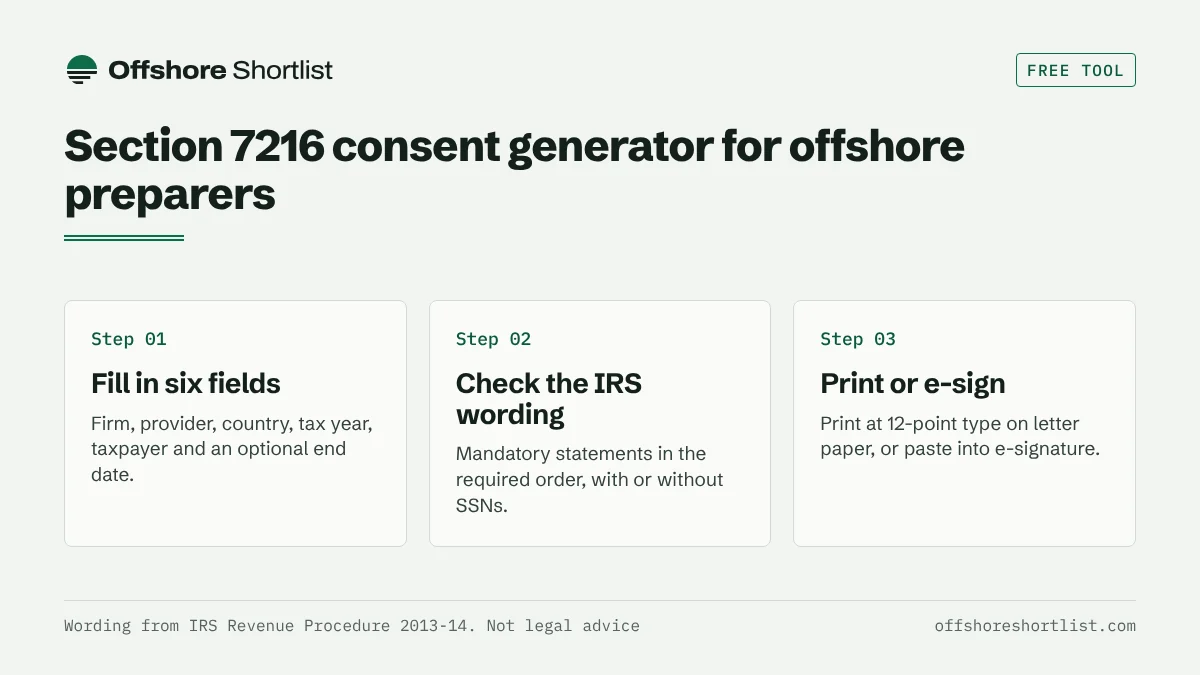
This generator builds a Section 7216 consent for a US tax firm that sends client return information to an offshore preparer. It uses the mandatory IRS statements from Revenue Procedure 2013-14 in the required order, adds your firm, provider and client details, and switches the outside-the-US paragraph depending on whether SSNs are shared. Copy it into your e-signature tool or print it at 12-point type on letter paper.
This tool is not legal advice. Have your counsel or professional liability carrier review the final form, and check the current text of Revenue Procedure 2013-14 before each filing season.
How do you use the consent generator?
Fill in your firm and provider, pick the SSN or masked version, and send the result to each client as a separate document before any of their files go offshore.
- Name the parties exactly. Use your firm’s legal name and the provider’s legal name from your contract.
- Pick the SSN option honestly. The SSN version tells clients both firms keep adequate safeguards. If you cannot stand behind that, mask SSNs and use the masked version.
- Send it as its own document. Each consent must be separate, and on paper every line must relate to that consent. An e-signature packet with the engagement letter works well.
- Wait for the signature. Do not assign the file offshore until the signed consent is back.
- Keep it unchanged. You cannot alter a consent after the client signs it.
What does each paragraph in the consent do?
The first two paragraphs are the standard section 5.04(1)(b) statements for disclosures to another preparer, the authorization names who gets what, the fourth paragraph is the outside-the-US statement from 5.04(1)(e), and the last is the TIGTA complaint statement from 5.04(1)(d).
| Part | Source in Rev. Proc. 2013-14 | Why it is there |
|---|---|---|
| Opening statement | Section 5.04(1)(b), first paragraph | Tells the client federal law requires the form and limits further protection |
| Not required, duration | Section 5.04(1)(b), second paragraph | Explains the client can refuse, and the one-year default |
| Authorization | Section 7 sample consent (Example 3) | Names the taxpayer, your firm, the provider, the purpose and the tax year |
| Outside the US | Section 5.04(1)(e)(i) or (e)(ii) | Required because the preparer is abroad; longer version when the SSN is shared |
| TIGTA | Section 5.04(1)(d) | Required in every consent: how to complain about misuse |
The full rules, penalties and rollout steps are in our Section 7216 guide for offshore tax prep. Wording source: Revenue Procedure 2013-14; disclosure rule: IRS Section 7216 FAQs.
What else should you set up before using offshore staff?
A written information security plan, a confidentiality contract with your provider, and a notice to clients that you use one.
Our offshore staffing guide covers all three, and the CPA Shortlist rankings show which providers publish SOC 2 Type II or ISO 27001 evidence you can rely on.
What else do CPA firms ask?
Is this a legally valid Section 7216 consent?
It uses the mandatory statements from Revenue Procedure 2013-14 word for word and in the required order, for a disclosure to a preparer outside the United States. Whether your consent is valid also depends on how you deliver it, who signs it and when. Have your counsel or professional liability carrier review your final form.
When should the client sign it?
Before any of their return information goes to the offshore preparer. The IRS requires the signed consent prior to disclosure, so most firms send it in the same e-signature packet as the engagement letter and hold the file until it comes back.
Should I choose the SSN version or the masked version?
Choose the SSN version only if both your firm and the offshore provider maintain adequate data protection safeguards, because the consent tells the client that you do. If your provider cannot see SSNs (they are fully masked or redacted), choose the masked version, which uses the shorter outside-the-US statement.
Can I e-sign the generated consent?
Yes. Revenue Procedure 2013-14 allows electronic consents if the signature method verifies the taxpayer agreed, such as a PIN of at least five characters or a typed name, and each screen can be printed. Paste the text into your e-signature tool as its own document.
Do I need one consent per client per year?
Each consent must be its own document, and if you do not state a duration it lasts one year from signature. Most firms collect a new consent each filing season with the engagement letter.