Offshore Staffing for Accounting Firms: The 2026 Guide
Everything a US CPA firm needs to decide whether to hire offshore: the three models, what it really costs, the IRS and AICPA rules, and a 90-day plan for your first seat.
Offshore staffing for accounting firms is the practice of hiring dedicated accountants, tax preparers or bookkeepers who work from another country, most often India, through a provider that employs them on your behalf. The person works on your clients’ files, inside your software, under your review. US firms use it because they cannot hire enough people at home: the BLS puts the median US accountant at $83,680 a year, and AICPA data shows first-time CPA exam candidates fell 34% between 2023 and 2024. An offshore staff accountant at a published $15 rate costs about $34,320 a year including review time. This guide covers the models, the real costs, the IRS and AICPA rules, and a 90-day plan for getting started.
What is offshore staffing for an accounting firm?
It is a dedicated hire who works only for your firm from another country, employed and managed day to day by a provider. You choose the person, set the work and review it; the provider handles payroll, office, equipment and local law.
That is different from classic outsourcing, where you send a batch of returns to a vendor and it decides who prepares them. With dedicated staff, the same person learns your clients, your checklists and your software over time, which is why most firms that stick with offshore work end up on the staffing model.
Why are US CPA firms hiring offshore now?
Because the US pipeline cannot cover demand. Fewer people are sitting the CPA exam, graduates are fewer, and experienced staff have left, while firms still have the same filing deadlines.
- Fewer exam candidates. First-time CPA exam candidates dropped from 42,626 in 2023 to 28,082 in 2024, and accounting degrees fell 6.6% to 55,152 in 2023-24 (AICPA 2025 Trends via the Journal of Accountancy). Part of the 2024 drop reflects candidates rushing to sit before the exam was redesigned in January 2024, but the longer trend points the same way.
- Experienced people left. About 17% of the US CPA workforce, more than 300,000 people, left the profession between 2019 and 2021 (SmartVault, citing the Wall Street Journal).
- Outsourcing is already normal. 47% of 600 firms surveyed reported outsourcing initiatives in 2023 (Going Concern).
- Private equity is accelerating it. After Blackstone bought Citrin Cooperman, its India headcount grew from about 300 to more than 1,000 (The Finance Story).
There is some good news for the long run: enrollment in four-year accounting programs rose 8.9% in spring 2026 (Journal of Accountancy). Those students will not be reviewing returns for several years, though, which is the gap offshore staff fill.
Which offshore model fits your firm?
Most small and mid-size firms should start with dedicated staff through a provider. Managed outsourcing suits firms with seasonal spikes and no spare review time, and your own India team only makes sense once you have 15 to 30 people offshore.
| Model | Who directs the work | How you pay | Best for | Watch for |
|---|---|---|---|---|
| Dedicated staff through a provider | You do, day to day | Hourly or monthly per person | Firms that want control and continuity | You need review capacity and clear checklists |
| Managed outsourcing | The provider | Per return, per task or per FTE | Seasonal peaks, firms short on reviewers | Less control over who touches files |
| Your own team (EOR or captive center) | You do, fully | Salary plus EOR fee or entity costs | Firms with 15+ offshore staff | You carry recruiting, retention and local compliance |
If you are weighing the third route, an employer of record (EOR) employs the staff in India on your behalf, so you can build your own team without setting up an Indian company. It usually makes sense only once you need 15 or more people and have someone to manage them locally.
What does offshore staffing cost?
Published starting rates run from $10 to $15 an hour for dedicated staff, which works out to roughly $21,000 to $31,000 a year for one full-time person before your own review time.
Annual cost of one full-time hire: US in-house vs offshore
US median wage plus benefits, compared with a dedicated offshore hire at a published starting rate.
- US in-house, loaded cost
- Offshore dedicated, with 10% oversight
View as table
| Role | US median wage | US loaded cost | Offshore rate | Offshore yearly | Lower by |
|---|---|---|---|---|---|
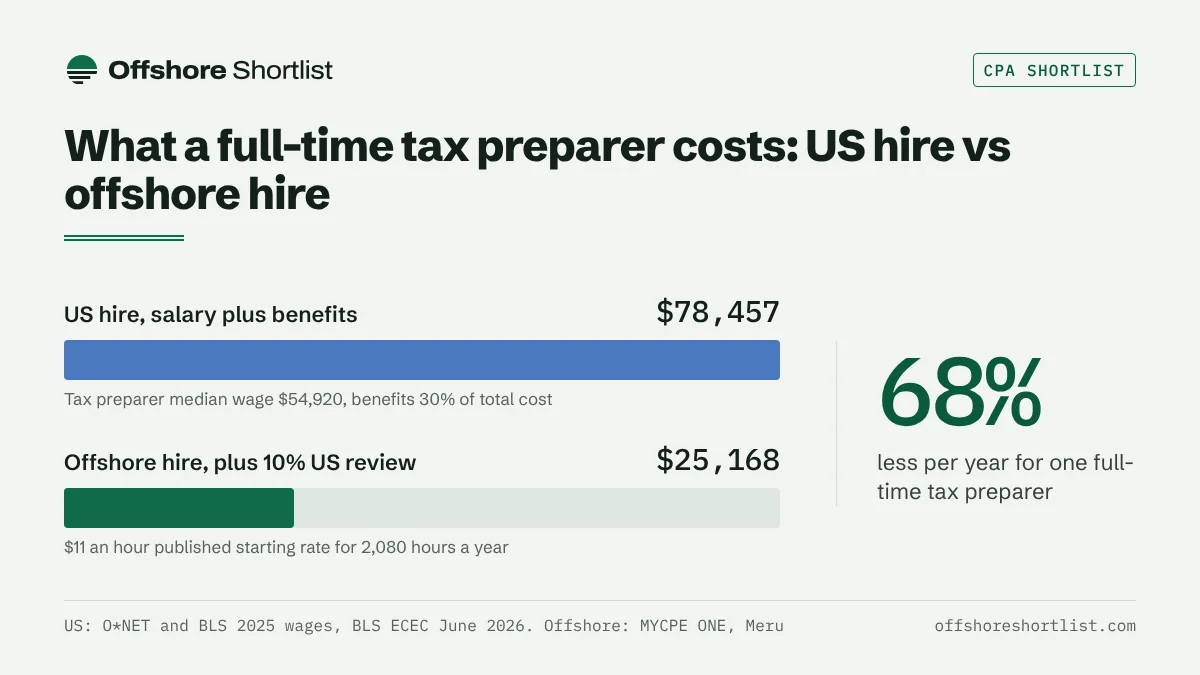
| Tax preparer | $54,920 | $78,457 | $11/hr | $25,168 | 68% |
| Staff accountant | $83,680 | $119,543 | $15/hr | $34,320 | 71% |
| Bookkeeper | $50,670 | $72,386 | $10/hr | $22,880 | 68% |
The real saving depends on three numbers you control: the rate you negotiate, how much of your US team’s time goes into reviewing and managing the work, and how many hours the person actually bills. Starting rates are for junior staff; experienced preparers and reviewers cost more. Use the cost calculator with your own salary and quotes, and compare firms’ published prices on the rankings page.
Which roles work best offshore?
Repeatable preparation work moves offshore most easily; anything that needs a license, a signature or a client relationship should stay in the US.
| Role | Good offshore tasks | Keep in the US |
|---|---|---|
| Tax preparer | 1040, 1120, 1120-S and 1065 preparation, organizer data entry, depreciation schedules | Final review, signing, client questions, planning advice |
| Bookkeeper / CAS | Bank and card reconciliations, AP/AR, monthly close, cleanups | Client calls, advisory, judgment on unusual items |
| Staff accountant | Financial statement prep, accruals, schedules, tie-outs | Engagement acceptance, sign-off |
| Audit support | Workpaper assembly, sampling, confirmations tracking, tie and foot | Opinion, risk assessment, independence decisions |
| Admin and documents | File naming, workflow updates, e-sign chasing, scanning QC | Anything that needs a client relationship |
How do time zones work with an India team?
India is 10 hours 30 minutes ahead of Eastern time in winter and 9 hours 30 minutes ahead in summer, so a day-shift team works while your office sleeps. You can also ask for an evening shift in India that overlaps your full workday.
Who is working when, shown in US Eastern time
India runs 10 hours 30 minutes ahead of Eastern Standard Time (9 hours 30 minutes during US daylight saving). India does not change its clocks.
Overnight turnaround is the main draw: you queue returns at 5 PM and review them at 8 AM. The trade-off is that questions wait a day. Many firms ask for two or three hours of overlap at the start of the US morning so review notes can be cleared live.
What are the legal and ethics rules?
Three sets of rules apply: IRS Section 7216 consent before return information leaves the US, a written information security plan under federal law, and AICPA rules on third-party service providers.
- Section 7216. A taxpayer must agree and sign a consent form before return information is disclosed to a preparer outside the United States. Social Security numbers can go only if the taxpayer consents and both firms keep adequate data safeguards; otherwise they must be masked (IRS Section 7216 FAQs).
- Security plan. The IRS says federal law requires tax and accounting professionals to create and maintain a written information security plan, and that they count as financial institutions under the Gramm-Leach-Bliley Act (IRS, August 2026). The FTC Safeguards Rule also expects you to choose providers that can keep data safe and to require it by contract (The Tax Adviser).
- AICPA ethics. Members using a third-party provider should have a confidentiality agreement with it and tell clients they use one, preferably in writing and before sharing data (Accounting Today; Journal of Accountancy).
The Section 7216 consent guide has the exact wording the IRS requires and a template you can adapt with your counsel.
How long does it take to get an offshore team running?
Plan on 6 to 12 weeks from first call to a productive person, even though providers advertise starts in days. The time goes into security checks, testing and building your review routine.
| Weeks | What happens | Done when |
|---|---|---|
| 1 to 2 | Shortlist three firms, request SOC 2 reports and ISO certificates, check references | Two firms pass your security review |
| 3 to 4 | Interview candidates, run a test return or reconciliation, compare quotes | You have a preferred person and a written price |
| 5 to 6 | Sign the contract and confidentiality terms, add Section 7216 consent to engagement letters, set up virtual desktop access | Access works and consents are going out |
| 7 to 10 | Pilot on lower-risk clients with a written checklist and full review | Review notes per file are falling week on week |
| 11 to 12 | Decide: scale, change person, or stop | A go or no-go decision on record |
What mistakes do firms make in the first year?
The common failures are timing, access and review: starting in January, letting staff download client files, and not budgeting the US time needed to review offshore work.
- Starting in busy season. A new person and a new process in February means rushed review. Start between June and October.
- Skipping consents. Sending returns before signed Section 7216 consents exposes the firm to IRS penalties and client complaints.
- Loose access. Staff should work inside your systems through a virtual desktop with downloads, USB and printing blocked.
- No written standards. Without checklists and sample workpapers, every return comes back done a slightly different way.
- One person, one point of failure. If one offshore hire leaves in March you are stuck. Ask the provider for a trained backup.
- Not counting review time. Budget 10% or more of the offshore cost for US review in the first year; it falls as the person learns your files.
How do you know whether it is working?
Track five numbers monthly: turnaround time, review notes per file, rework rate, files completed per week and cost per file. If review notes are not falling after 60 days, change something.
Compare cost per finished file, not hourly rates, because a cheaper person who needs twice the review is not cheaper. Ask the provider to report hours and output weekly, and keep one internal owner who meets the offshore team at least weekly.
Ready to compare firms? See the 10 best offshore accounting firms for CPA firms, or get a shortlist matched to your roles and software.
What else do CPA firms ask?
How do I start offshoring at a small CPA firm?
Start with one dedicated seat for a repeatable task, such as 1040 preparation or monthly bookkeeping, and pilot it outside busy season. Get Section 7216 consents into your engagement letters first, give the person access only through a secure virtual desktop, and write a review checklist before the first file goes over.
How much does an offshore tax preparer cost?
At the $11 per hour starting rate that MYCPE ONE and Meru Accounting publish, a full-time offshore tax preparer costs about $22,880 a year for 2,080 hours, or about $25,168 once you add 10% for your own review time. A US tax preparer at the BLS median wage costs about $78,457 with benefits.
Can offshore staff sign or file returns for my firm?
Offshore staff can prepare returns and workpapers, but the signing preparer and the firm stay responsible for the return. Keep review, sign-off, client communication and e-file authorization with your US team, and make that clear in your engagement letter and your contract with the provider.
Is offshore staffing the same as outsourcing?
No. Offshore staffing gives you a named, dedicated person who works on your files under your direction. Outsourcing means sending work to a provider that assigns its own people and usually charges per return or per task. Many firms start with outsourcing and move to dedicated staff once volume is steady.
How long does it take to onboard an offshore accountant?
Providers advertise anywhere from 24 hours to 10 working days to start, but a realistic plan is 6 to 12 weeks from first call to a productive person: two weeks to shortlist and check security, two weeks to interview and test, two weeks to contract and set up access, then a pilot period with close review.
What tasks should stay in the US?
Keep anything that needs a license, a signature or a client relationship onshore: final review and signing, tax planning advice, client meetings, engagement acceptance and anything that requires judgment about a client’s facts. Preparation, reconciliations, workpaper assembly and data entry move offshore most easily.
Where do these facts come from?
- BLS Occupational Outlook Handbook: Accountants and Auditors
- O*NET OnLine: Tax Preparers wages (BLS 2025 data)
- BLS: Compensation costs for private industry workers, June 2026
- Journal of Accountancy: The accounting graduate pipeline (AICPA 2025 Trends)
- Journal of Accountancy: Student enrollment in accounting continues to rise (June 2026)
- SmartVault: The great accounting exodus (citing the Wall Street Journal)
- Going Concern: Almost half of firms are outsourcing work
- The Finance Story: Citrin Cooperman’s India headcount
- IRS: Section 7216 frequently asked questions
- IRS IR-2026-92: Tax pros need a written information security plan
- The Tax Adviser: Complying with the Safeguards Rule for information security
- Accounting Today: AICPA adopts ethics requirements for members who outsource
- Journal of Accountancy: AICPA confidentiality rule and third-party service providers