How We Score Offshore Accounting Firms
The rules behind every score on Offshore Shortlist: six criteria, one evidence standard, and no paid placements.
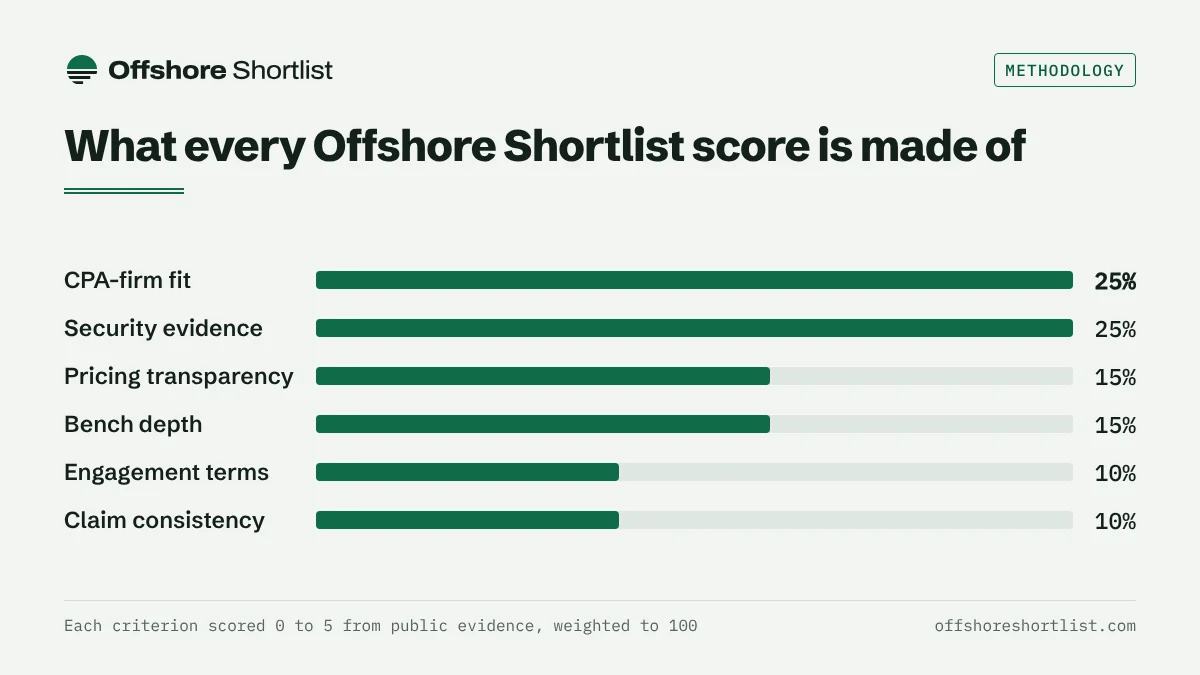
We score each offshore accounting firm from 0 to 5 on six criteria, weight them to 100 points, and divide by 10 for a score out of 10. Every score uses only information the firm publishes on its own website, read on a stated date. No firm can pay to be included or to change its position.
What criteria do we use?
CPA-firm fit and security evidence carry 25% each, pricing transparency and bench depth 15% each, and engagement terms and claim consistency 10% each.
| Criterion | Weight | What earns a 5 |
|---|---|---|
| CPA-firm fit | 25% | Does the firm build its service around US CPA and EA practices: US tax season, 1040/1120/1065 work, review layers and firm software? |
| Security evidence | 25% | Is there a named, checkable credential such as a SOC 2 Type II report or an ISO 27001 certificate, stated in plain text rather than as a badge? |
| Pricing transparency | 15% | Does the firm publish a rate or price list, so you can compare before a sales call? |
| Bench depth | 15% | How many trained staff can it draw on when your busy season peaks or someone leaves? |
| Engagement terms | 10% | Trial periods, part-time options, replacement guarantees and how quickly a team starts. |
| Claim consistency | 10% | Do the firm’s own pages agree with each other on headcount, client count, certifications and terms? |
What does each score mean?
A 5 means clear, specific, checkable evidence on the firm’s own site; a 1 means the information is missing or only implied.
- 5: Named and specific, such as “SOC 2 Type II” or “starting at $11 per hour.”
- 4: Clearly stated but missing one detail, such as SOC 2 without the type.
- 3: Partly stated, or stated only as a badge or logo.
- 2: Vague, or contradicted elsewhere on the site.
- 1: Not found.
Where does the evidence come from?
From each firm’s public website only. We record the page, the exact wording and the date we read it, and we link the source in every profile.
We do not use paid surveys, vendor-supplied rankings or anonymous reviews. When a firm’s pages disagree with each other, we report both figures and reflect it in the claim-consistency score rather than picking the more flattering number.
How are ties broken?
By CPA-firm fit first, then security evidence. If both are equal, firms share a position and are listed alphabetically.
How often are rankings updated?
At least every quarter, and within ten business days when a firm sends new evidence.
To be re-scored, a firm can send a current SOC 2 report (under NDA if needed), an ISO certificate with its expiry date, a published price list or a correction, with a link to where it appears publicly. Email hello@offshoreshortlist.com. We will not change a score in exchange for payment, and we will say on the page when a firm pays us a referral fee.
How is our content made?
The Offshore Shortlist Research Desk drafts each page with help from AI tools, a human fact-checks every number and claim against its source, and our editor approves the page before it goes live.
- Who: pages carry the Research Desk byline and the name of the editor who approved them. We do not invent authors, headshots or credentials.
- How: AI tools help with research, outlines and first drafts. Every statistic, price and legal statement is checked by a person against the linked source, and each source is opened twice: once when drafted, once before publishing.
- Why: to help buyers choose a provider and avoid mistakes. We do not publish pages to fill keywords, and we update or remove pages that go out of date.
This follows Google’s guidance on creating helpful, people-first content and on using generative AI content. Spot an error? Email hello@offshoreshortlist.com and we will fix it and note the change.
What are the limits of this method?
We score what firms publish, not what they deliver day to day. A firm with excellent service and a thin website can score lower than it deserves.
That is why every profile ends with a question to ask, and why we suggest a pilot outside busy season before any long commitment. Read our current rankings and the disclosure policy.