Offshore Staffing Cost Calculator: US Hire vs Offshore Hire
Put in a salary, an offshore quote and the number of seats for any role. The ledger shows what one year really costs on each side, including benefits and your own review time.
Hiring one full-time tax preparer offshore at the published $11 starting rate costs about $25,168 a year including US review time, compared with about $78,457 for a US hire at the median wage of $54,920 once benefits are added. The same math works for any role: pick “Any other role” and enter your own salary and quote.
- US salary
- $54,920
- Benefits and payroll taxes30% of total employer cost
- $23,537
- US hire, loaded
- $78,457
- Offshore hire$11/hr x 2,080 hours
- $22,880
- US review time10% of offshore cost
- $2,288
- Offshore, all in
- $25,168
- Lower by
- 68%
- Yearly difference, all seats
- $53,289
Hiring one tax preparer offshore costs about $53,289 less per year than hiring in-house, 68% lower.
Your inputs are saved in the page address, so you can copy the link and send the comparison to a partner.
How does this calculator work?
It compares the full yearly cost of one US employee with one dedicated offshore hire doing the same 2,080 hours, then multiplies by the number of seats.
- US loaded cost = salary ÷ (1 − benefits share). With the default 30%, a $54,920 salary becomes about $78,457.
- Offshore cost = hourly rate × 2,080 hours, plus your review time as a percentage.
- Difference = US loaded cost minus offshore cost, per seat and for all seats.
Where do the default numbers come from?
US salaries are national medians from the Bureau of Labor Statistics, benefits use the BLS private-industry share, and offshore rates are the lowest prices that offshore firms publish.
| Role | US median salary | Source | Default offshore rate | Rate source |
|---|---|---|---|---|
| Tax preparer | $54,920 | O*NET OnLine, Tax Preparers national wages (BLS 2025 wage data) | $11/hr | Published starting rate (MYCPE ONE and Meru Accounting) |
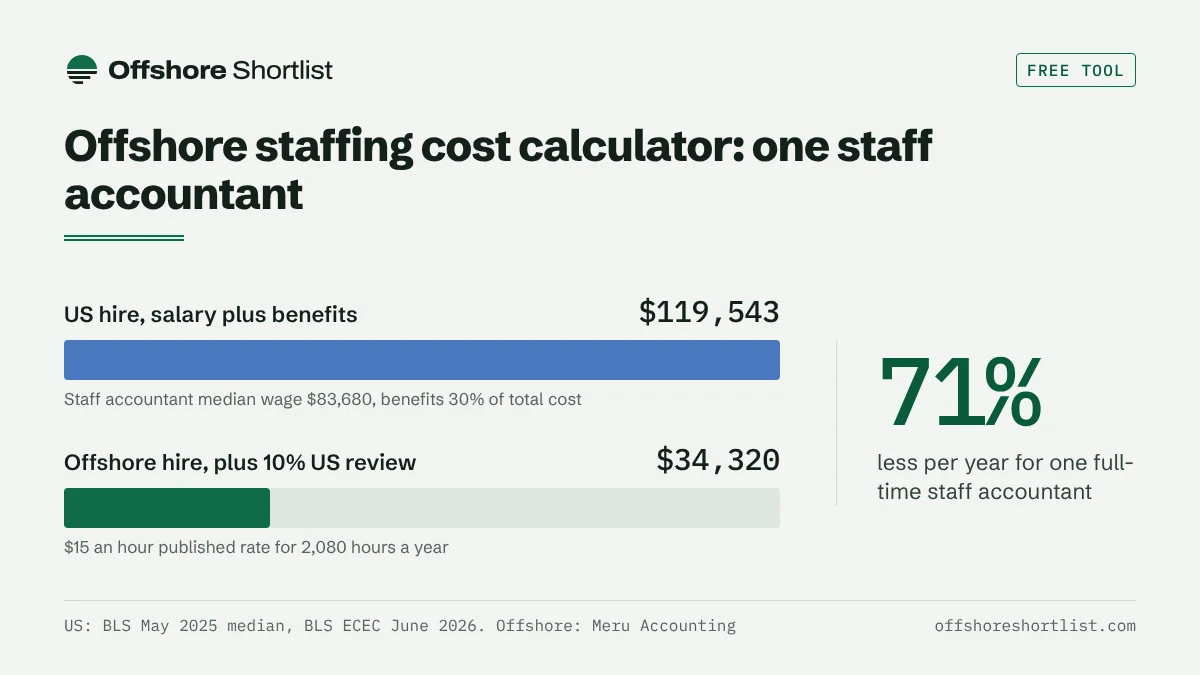
| Staff accountant | $83,680 | BLS Occupational Outlook Handbook, Accountants and Auditors (May 2025 median) | $15/hr | Top of Meru Accounting’s published $11 to $15 range for complex accounting |
| Bookkeeper | $50,670 | BLS Occupational Outlook Handbook, Bookkeeping, Accounting, and Auditing Clerks (May 2025 median) | $10/hr | Published starting rate (Meru Accounting) |
Benefits share: BLS Employer Costs for Employee Compensation, June 2026, where benefits were 30.0% of private employers’ costs. Published offshore rates are compared on the rankings page.
What does the calculator leave out?
Recruiting fees, overtime, US office space, software seats and the cost of a bad hire are not included, and each one usually widens the gap in favor of offshore.
Two items can narrow it: Indian public holidays (ask whether the provider bills only hours worked, as MYCPE ONE says it does) and the first season’s extra review time. If you are planning several seats, read the offshore staffing guide before you commit, and check the Section 7216 consent rules for tax work.
What else do buyers ask?
How is the US loaded cost calculated?
We divide the salary by 0.70. In June 2026, wages and salaries were 70.0% of private employers’ compensation costs and benefits were the other 30.0%, according to the BLS. Change the benefits share if your firm’s package is richer or leaner.
Why add oversight time to the offshore cost?
Someone in your US office reviews the work, answers questions and manages the relationship. We default that time to 10% of the offshore cost. Firms in their first season often spend more; firms with mature checklists spend less.
Does the calculator include the provider’s fees?
Yes. Offshore providers quote an all-in hourly or monthly rate that covers salary, benefits, office, equipment and their margin. Enter the rate from your quote. If a provider charges a separate setup or software fee, add it to your comparison by hand.
Are the default rates realistic?
They are published starting rates: $11 an hour for a tax preparer, $10 for a bookkeeper and $15 for a staff accountant. Experienced people and reviewers cost more, so replace them with your quotes.