Section 7216 Consent for Offshore Tax Preparation
The rules a US CPA firm must follow before client return information goes to an offshore preparer, the exact IRS wording, and a template you can adapt with your counsel.
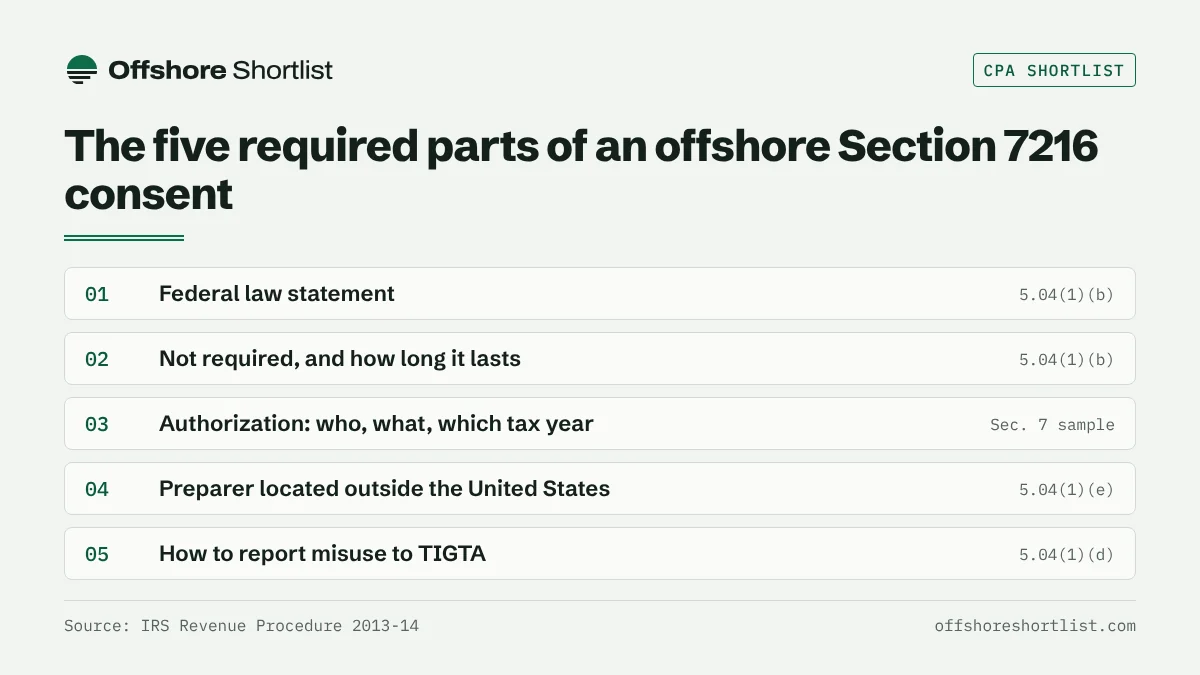
Section 7216 of the Internal Revenue Code makes it a crime for a tax preparer to disclose or use a client’s return information without permission. For CPA firms using offshore staff, the rule that matters is this: the IRS says that when another preparer helping with the return is located outside the United States, the taxpayer must agree and sign a consent form before anything is shared. If the client’s Social Security number will be visible to that preparer, both firms must keep adequate data safeguards and the consent must say so. Revenue Procedure 2013-14 gives the exact sentences an individual taxpayer’s consent must contain.
This page explains the rules and quotes the IRS wording, but it is not legal advice. Confirm the current regulations and Revenue Procedure 2013-14 with your counsel or professional liability carrier before you use any consent form.
What is Section 7216?
It is the federal law that limits how tax preparers can disclose or use the information clients give them. It carries both criminal and civil penalties.
Under IRC Section 7216, a convicted preparer can be fined up to $1,000 for each violation and imprisoned for up to a year. A separate civil penalty under Section 6713 is $250 per improper disclosure or use, and the IRS points out that the civil penalty does not require the disclosure to be knowing or reckless (IRS Section 7216 FAQs). The IRS keeps its guidance in the Section 7216 Information Center.
When do you need consent to use offshore staff?
Whenever return information will reach a preparer located outside the United States, including your own provider’s staff in India or the Philippines. The consent must be signed before the first disclosure.
Normally, disclosing information to another preparer who helps you prepare the return does not need the client’s consent. The exception is location: if that preparer is outside the US, “the taxpayer must agree and sign a form consenting to the disclosure,” in the IRS’s words (IRS FAQ). The CPA Journal makes the same point: consent is always required before disclosure to a preparer abroad (The CPA Journal).
Can you send Social Security numbers offshore?
Yes, but only with the taxpayer’s consent and only if both the US firm and the offshore firm maintain adequate data protection safeguards. Without both, you must mask or redact the SSN first.
The consent itself changes when the SSN is included. Revenue Procedure 2013-14 requires a longer statement telling the taxpayer that their SSN may be disclosed, that both preparers keep safeguards as the 7216 regulations require, and that federal agencies may not be able to enforce US privacy laws against a preparer abroad (Rev. Proc. 2013-14, section 5.04(1)(e)).
How do you decide what each client needs?
Work through four questions for each client before any of their files go to your offshore team.
If yes, you need a signed consent before disclosure. If no, Section 7216 offshore consent does not apply to this file.
If yes, use the SSN version of the consent and confirm both firms keep adequate safeguards. If no, mask every SSN fully and use the shorter statement.
If yes, follow Revenue Procedure 2013-14: mandatory sentences in order, separate signed document, 12-point type on paper. For business clients, agree the format with counsel.
Only then can the file go offshore. If a client declines, keep that client’s work with your US team.
What must the consent form say?
For an individual taxpayer, the form must include the mandatory statements from section 5.04(1)(b), the TIGTA statement from 5.04(1)(d) and the outside-the-US statement from 5.04(1)(e), and the taxpayer must sign and date it.
- Section 5.04(1)(b) covers disclosure to another preparer for help preparing the return. Its sentences must appear in the order the IRS gives.
- Section 5.04(1)(d) tells the taxpayer they can complain to the Treasury Inspector General for Tax Administration.
- Section 5.04(1)(e) applies because the recipient is abroad: version (i) when the SSN is masked, version (ii) when it is included.
- Affirmative and signed. The taxpayer must actively agree (no opt-out boxes) and sign. You cannot change the form after they sign.
- Separate document. Each consent sits on its own written document, and on paper every line must relate to that consent. Paper forms need 8.5 by 11 inch sheets and at least 12-point type.
- Duration. If you do not state one, the consent lasts one year from the signature date.
- Electronic is fine. Text must be as large as the site’s body text, with enough contrast, and each screen must be printable and signable (Rev. Proc. 2013-14, sections 5 and 6).
Is there a template you can adapt?
Yes. The template below uses the mandatory IRS sentences word for word, with placeholders for your firm, your provider and the client. It is the SSN-included version; the note under it shows how to adapt it if you mask SSNs.
Consent to Disclose Tax Return Information
Federal law requires this consent form be provided to you. Unless authorized by law, we cannot disclose your tax return information to third parties for purposes other than those related to the preparation and filing of your tax return without your consent. If you consent to the disclosure of your tax return information, Federal law may not protect your tax return information from further use or distribution.
You are not required to complete this form. Because our ability to disclose your tax return information to another tax return preparer affects the tax return preparation service(s) that we provide to you and its (their) cost, we may decline to provide you with tax return preparation services or change the terms (including the cost) of the tax return preparation services that we provide to you if you do not sign this form. If you agree to the disclosure of your tax return information, your consent is valid for the amount of time that you specify. If you do not specify the duration of your consent, your consent is valid for one year from the date of signature.
I, [TAXPAYER NAME], authorize [YOUR FIRM NAME] to disclose to [PROVIDER LEGAL NAME], located in [COUNTRY], my tax return information, including my Social Security Number, to allow [PROVIDER LEGAL NAME] to assist in the preparation of my [TAX YEAR] individual income tax return. This consent is valid until [DATE].
This consent to disclose may result in your tax return information being disclosed to a tax return preparer located outside the United States, including your personally identifiable information such as your Social Security Number (“SSN”). Both the tax return preparer in the United States that will disclose your SSN and the tax return preparer located outside the United States that will receive your SSN maintain an adequate data protection safeguard (as required by the regulations under 26 U.S.C. section 7216) to protect privacy and prevent unauthorized access of tax return information. If you consent to the disclosure of your tax return information, federal agencies may not be able to enforce United States laws that protect the privacy of your tax return information against a tax return preparer located outside of the United States to whom the information is disclosed.
If you believe your tax return information has been disclosed or used improperly in a manner unauthorized by law or without your permission, you may contact the Treasury Inspector General for Tax Administration (TIGTA) by telephone at 1-800-366-4484, or by email at complaints@tigta.treas.gov.
Want it filled in for you? The Section 7216 consent generator builds this form with your firm, provider and client details, in the right order, ready to print at 12-point on letter paper.
Masking SSNs instead? Remove “including my Social Security Number” from the authorization, and replace the long outside-the-US paragraph with the shorter section 5.04(1)(e)(i) statement: “This consent to disclose may result in your tax return information being disclosed to a tax return preparer located outside the United States.” For joint returns, ask counsel how your firm should collect each spouse’s consent.
Wording sources: Rev. Proc. 2013-14, sections 5.04(1)(b), (d) and (e)(ii), and the section 7 sample consent. Check the current IRS text before each filing season.
How do you roll consents out across your client base?
Send the consent as its own document in the same e-signature packet as your engagement letter, track who signs, and route non-signers to your US team before busy season starts.
- Decide which clients go offshore. Start with returns that fit a checklist: W-2 households, simple Schedule C, rental properties.
- Pick SSN or masked. If your provider works in your systems through a secure virtual desktop with a SOC 2 Type II report, the SSN version is common. Otherwise mask.
- Send with the engagement letter. A separate document in the same packet, not a clause inside the letter.
- Track status per client. Add a “7216 offshore consent” field to your practice management system and block offshore assignment until it is signed.
- Renew each year. State a duration, or rely on the one-year default and re-collect each season.
What other rules apply when you use offshore staff?
Two more: a written information security plan, which the IRS says federal law requires of tax and accounting professionals, and AICPA rules on third-party service providers.
- Written information security plan. The IRS says tax and accounting professionals count as financial institutions under the Gramm-Leach-Bliley Act and must keep a written plan; Publication 5708 provides a template (IRS IR-2026-92). Security events affecting 500 or more people must generally be reported to the FTC within 30 days of discovery.
- FTC Safeguards Rule. Name a qualified individual, run risk assessments, encrypt customer information, require multifactor authentication, and oversee service providers by contract. Firms with fewer than 5,000 customers are exempt from some written-document requirements (The Tax Adviser).
- AICPA confidentiality. Before sharing confidential client information with a third-party provider, either have a contract that requires confidentiality and appropriate safeguards or get the client’s specific consent (Journal of Accountancy). Members should also tell clients they use a provider, preferably in writing and before sharing data (Accounting Today).
When you compare offshore firms, ask how they support all three. Our rankings list each firm’s published security credentials, and the offshore staffing guide covers the rest of the setup.
What else do CPA firms ask?
Do I need Section 7216 consent to use an offshore tax preparer?
Yes. Sharing return information with another preparer who helps prepare the return usually does not need consent, but the IRS says that if that preparer is outside the United States, the taxpayer must agree and sign a consent form first. The consent must be signed before any disclosure.
Can I send a client’s Social Security number to India?
Only if the taxpayer consents and both the US preparer and the preparer abroad maintain adequate data protection safeguards. Otherwise, the IRS says you must redact or mask the SSN before disclosing the return information.
What is the penalty for violating Section 7216?
Under IRC Section 7216, a convicted preparer may be fined up to $1,000 per violation and imprisoned for up to one year. Section 6713 adds a civil penalty of $250 per improper disclosure or use, and the IRS notes the civil penalty does not require the disclosure to be knowing or reckless.
Can the consent be signed electronically?
Yes. Revenue Procedure 2013-14 allows consents to be furnished on paper or electronically. Electronic consents need a signature method that verifies the taxpayer agreed, such as a PIN of at least five characters or a typed name, and each screen must be printable.
How long does a Section 7216 consent last?
As long as the taxpayer specifies. If the consent does not state a duration, Revenue Procedure 2013-14 says it is valid for one year from the date the taxpayer signs.
Can I put the consent inside my engagement letter?
Not as a clause. For individual taxpayers, each consent must be on its own written document, and every line on the page must relate to that disclosure. Send it alongside the engagement letter, often in the same e-signature packet, as a separate document.
Where do these facts come from?
- IRS Revenue Procedure 2013-14 (Section 7216 consent requirements)
- IRS: Section 7216 frequently asked questions
- IRS: Section 7216 Information Center
- The CPA Journal: Getting taxpayers’ consent under IRC Section 7216
- IRS IR-2026-92: Tax pros need a written information security plan
- The Tax Adviser: Complying with the Safeguards Rule for information security
- Journal of Accountancy: AICPA confidentiality rule and third-party service providers
- Accounting Today: AICPA adopts ethics requirements for members who outsource